
Good News: An enewsletter for donors and nonprofits
on strategic planning, governance, fundraising, and executive leadership.

Meaningful Work
As New England days get shorter, temperatures drop, illness spreads, and the pace of work speeds up, I'm wondering what the successful business person in “retirement,” the company aiming to make more than just profit, the individual who knows she has more than enough money, and the nonprofit staff showing up for other people every day and against all odds have in common?
They all get out of bed in the morning with the intrinsic motivation that comes from chasing more than financial assets and material wealth. They understand that intrinsic motivation beats extrinsic motivation every time, especially as conditions become more challenging.
So what are the hallmarks of meaningful work? Here are a few:
Service to Others
It is not hard to notice that so many in the spotlight today are there because of what they want for themselves. Politicians, business leaders, athletes, and entertainers accumulate more and more, often for themselves only. Countless studies make it clear that the only reliable path to meaning (and happiness) is devotion to something or someone bigger than ourselves. Our nation’s military academies may be the best example of this as their students do not report nearly the same levels of anxiety and depression as those at our so-called elite academic institutions. It seems that West Point's "Duty, Honor, Country" is much more than a credo.
More than Money and Things
While many today receive signals that financial and material wealth are everything when pursuing a career, the most productive workers find the greatest compensation in work-life balance, a culture of respect, opportunities to grow, and yes, meaningful work. Those seeking to serve others report high levels of job satisfaction and health. It is not hard to see that while a certain amount of money is needed to avoid the trauma and hardships of not having enough, the persistent accumulation of money and things for their own sake can bring a soul sucking, hollowed out feeling (and poor physical and mental health) that can't be ameliorated by ever increasing net worth and stuff.
The Thrill of the Challenge
The challenges presented to those who want to help are immense: feeding people in need of food, housing people with no shelter, protecting precious spaces and natural resources, providing education, health, and joy to people with limited opportunities for each. As much of government, business, media, and academia continue their decades long retreat from the common good, consumer-oriented, profit-driven culture seems to steer people away from doing good and promoting their own health. Someone interested in doing good would seemingly need to be an irrational person who relishes a kind of thrill in taking on difficult to nearly impossible tasks because the market has failed to address or even created such desperate circumstances.
We Know It When We Have It
Like speed on a track, there is no way to fake finding meaning in our work. There are many ways to find meaning in government, for profit, and nonprofit arenas but the only way to grasp it is to experience for yourself what gives you meaning. It is unique to each of us. Meaning can occur in the public and private sectors. No credentialing scheme or status symbols can be acquired to signal happiness and goodness. We simply know it when we see it and have it.
With Thanksgiving around the corner and the fifth anniversary of To the Good approaching in January, I am grateful for my donor and nonprofit clients’ examples of courage, optimism, humility, persistence, and supreme competence. I see you and hope that more of our leaders will follow your playbooks so that they help rather than hinder your progress.
Happy Thanksgiving.
Stuff Steve is Watching, Listening to, and Reading
The Meaning of Life (12 minute watch)
"It was incredibly simple. He said, 'The meaning of life is service to others.' That's it. He said, 'When you are of service to others, that will vanquish your own inadequacies, your anxieties, your depression, it brings you into the moment, and, not only that, it makes the world a better place. And there are a lot of people that need a lot of service right now.' So shifting humanity's entire focus from self interest to other interest was his entire thesis about the meaning of life." Rainn Wilson (Dwight Schrute) on talking with a Tibetan Monk in conversation with Rich Roll
Watch Here
Soul Boom (76 minute listen)
"There's always things to be outraged about. The point is that your outrage, per se, is not going to solve a problem. Substitute your anger and attention for actually doing something that helps humanity. If you're upset about what is happening in Ukraine, go help somebody in your community. Go actually do something that helps humanity and mobilize your concern about something in one part of the world where you can't do anything about it to somewhere where you can. If you're really concerned about poverty in sub-Saharan Africa, then go help a homeless person in your community. It will make you happier and actually solve a problem rather than be caught up in someone's for profit outrage machine where some Boomer is making bank off of your outrage. Don't let old people use you for their profit from their outrage machines." Arthur Brooks in Conversation with Rainn Wilson on Soul Boom
Listen Here
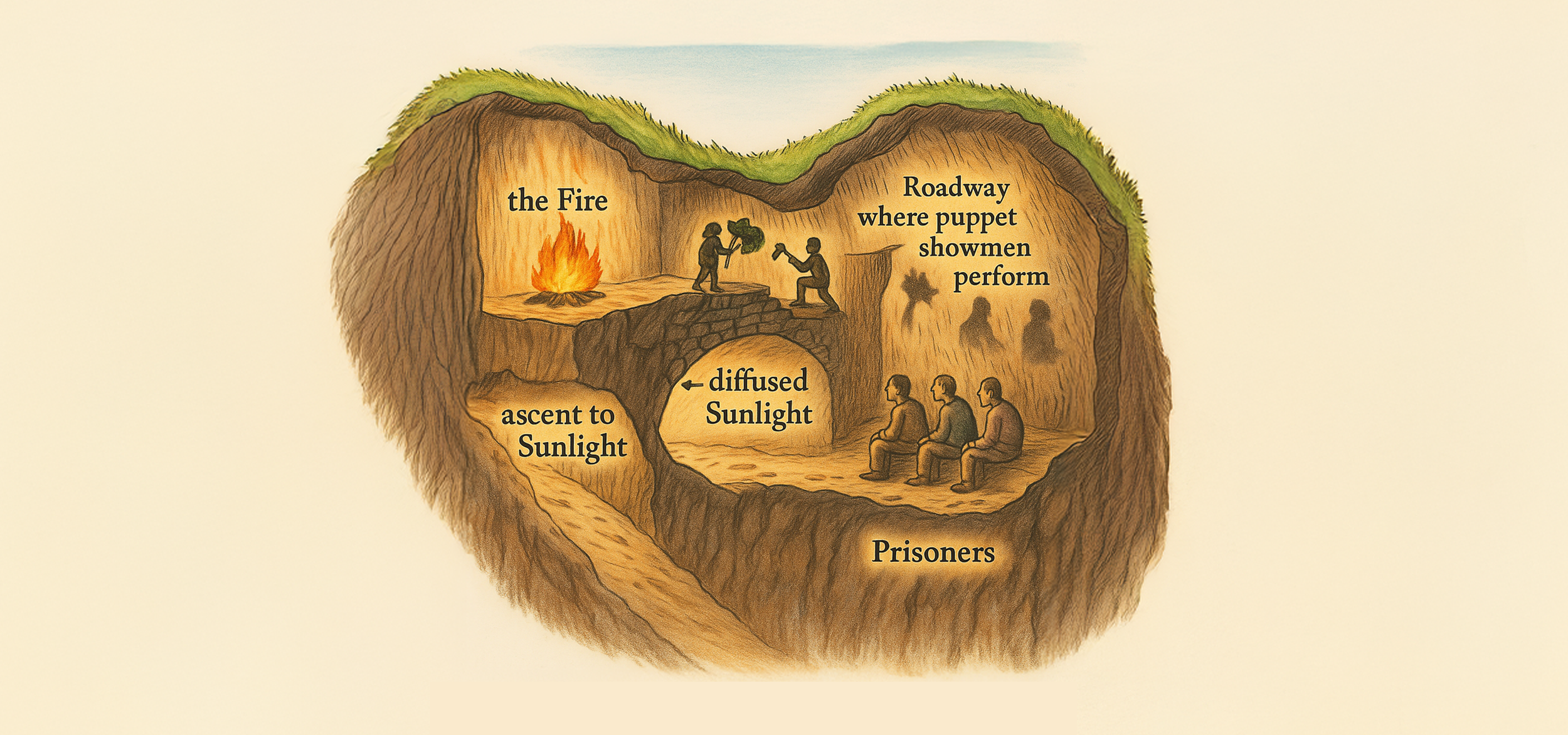
The Allegory of the Cave (10 minute read)
"Plato says that the 'prisoners would in every way believe that the truth is nothing other than the shadows.' Indeed they would not suspect that the things they see are but shadows, nor even have the concept of a shadow. They pass the time in trivial games of shadow-prediction, unaware of their keepers, the fire, or the parade of objects behind them. Though they are troglodytes in extremis, they do not feel claustrophobic or deprived. The actual circumstances of their confinement in the dark cavern, the possibility of a way up and out, and indeed the notion that there may be an incandescent world of wonders to ascend to, are unknown and unsuspected. Life is what it is, what it has always been; they do what they do and feel what they feel because they know nothing else. They are ignorant. But we know … and it is terrifying. Because Plato has, through his narrative, given us privileged knowledge of their situation, we know what they do not; we can affirm their ignorance." Plato's Cave and the Stubborn Persistence of Ignorance, Professor Daniel DeNicola